DODOMA, TANZANIA – In a major victory for digital freedom advocates across Africa, the High Court of Tanzania has dismissed a series of government attempts to block a constitutional challenge against the 90-day suspension of JamiiForums. The ruling, delivered on March 16, 2026, marks a critical turning point in a saga that began when the state shuttered the country’s most popular digital public square over a controversial livestream.
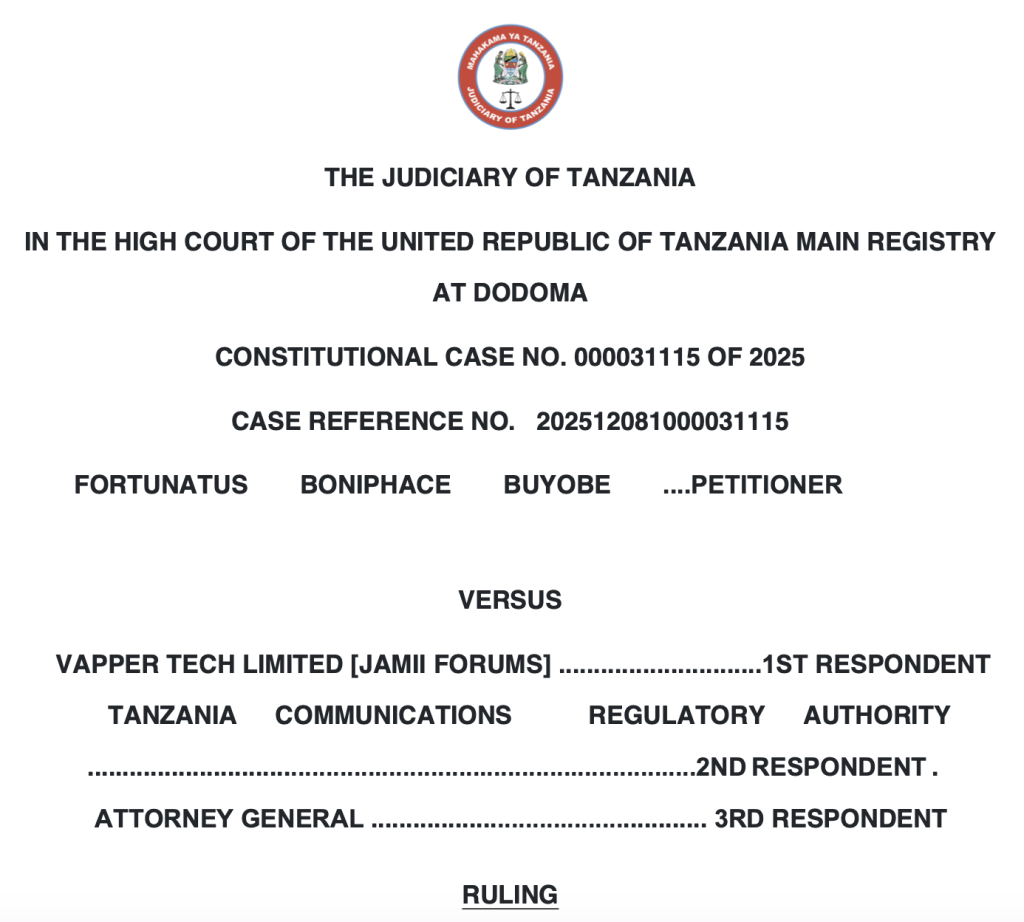
The case, Fortunatus Boniphace Buyobe v. Vapper Tech Limited (JamiiForums), Tanzania Communications Regulatory Authority & The Attorney General, Constitutional Case No. 000031115 of 2025, is now proceeding to a full hearing on the merits before the High Court of Tanzania in Dodoma. While the government argued that the court had no business hearing the petition, a three-judge panel comprising Hon. Dr. L. Mongella, A. Kirekiano, and H. Kinyaka ruled that the case was “competent” and must be decided on its merits.
Its outcome could redraw the boundaries of regulatory power over online platforms across the continent — but the journey that brought it this far has already sent a chilling signal about the personal cost of exercising constitutional rights in Tanzania’s digital space.
The Origins of a Digital Blackout
The crisis erupted on September 6, 2025, when the TCRA issued a public statement announcing the immediate suspension of Vapper Tech Limited’s license, the parent company of JamiiForums. The regulator alleged that the platform had published “misleading content” that “insulted and disparaged” President Samia Suluhu Hassan and the Government.
JamiiForums — operated by Dar es Salaam-based technology company Vapper Tech Limited — is Tanzania’s leading civic discussion and social networking platform, hosting millions of users across political, social, economic, and whistleblowing forums. Founded by Maxence Melo, it has for over a decade served as a rare digital public square in a country where press freedom indices remain under sustained pressure.
On 6 September 2025, the Tanzania Communications Regulatory Authority (TCRA) issued a public notice —announcing the immediate 90-day suspension of JamiiForums’ online content services licence, citing violations of the Electronic and Postal Communications (Online Content) Regulations, 2020, as amended in 2022 and 2025.
The stated trigger was a livestream broadcast by Humphrey Polepole, a former Tanzanian ambassador to Cuba, transmitted on 4 September 2025 across multiple social media platforms, including JamiiForums. According to TCRA’s formal summons to JamiiForums (Case No. 05-2025/2026, issued to the platform’s Content Committee on 5 September 2025), the platform was accused of publishing photographs and commentary relating to a meeting between President Samia Suluhu Hassan and Zimbabwean businessman Wicknell Chivayo, as well as claims made by Polepole about the undervalued sale of a coal mine to businessman Rostam Aziz — all without seeking official comment from the government or verifying the content.
The TCRA’s suspension letter, issued the following day under Section 114 of the Electronic and Postal Communications Act (Cap. 306), declared that JamiiForums had published content that was “misleading to the public, insulting and disparaging to the Government and the President of the United Republic of Tanzania” in violation of Regulations 9(a), (c), (e), (g) and (j), 12(a)(i), 15A and 16(1), along with Paragraphs 3(a), 9 and 10 of the Second Schedule to the Online Content Regulations. The licence was suspended for 90 days, effective 6 September 2025, with access to the platform blocked in Tanzania.
The speed of the process was itself a flashpoint. JamiiForums received TCRA’s summons on 5 September 2025 and was required to appear before the Content Committee the same evening. According to the committee’s own decision document, JamiiForums requested 24 hours to submit a fuller written defence; the committee allowed a written submission, then proceeded to issue its ruling by 6 September morning — the same day the public suspension notice was released.
Speaking to BBC Swahili after the suspension, Maxence Melo maintained that the action was disproportionate and threatened civic discourse in Tanzania, calling for dialogue rather than outright platform shutdowns. Melo clarified the platform’s position: “We do not agree with the directive, but we have complied to respect the law. However, we believe this sets a dangerous precedent for the future of digital rights and freedom of expression in Tanzania.”
The Legal Counter-Strike: Buyobe vs. The State
On 4 December 2025, Fortunatus Boniphace Buyobe — a verified JamiiForums member since November 2011 with 463 posts to his name — filed a constitutional petition before the High Court of Tanzania at Dodoma, represented by advocate John Seka of Seka & Associates.
Buyobe argued that the state didn’t just punish a company (Vapper Tech); it silenced its citizens. His petition claims the suspension violated his constitutional rights to seek, receive, and impart information under Article 18 and his right to associate under Article 20.
His affidavit of admissibility was unambiguous: “Following the official suspension, JamiiForums became inaccessible in Tanzania. I could not post content nor read previously posted material.” He described the platform as “my preferred digital platform” through which he contributed to and received information on matters of public importance.
Beyond the personal rights dimension, the petition challenged the constitutional validity of several provisions of the Online Content Regulations themselves — specifically Regulations 9(a), (c), (e), (g) and (j); 12(a)(i); 15A; and 16(1), along with Paragraphs 3(a), 9 and 10 of the Second Schedule — as being “overly broad and ambiguous” and thereby preventing citizens from effectively exercising their constitutional rights.
Critically, Vapper Tech — the first respondent — filed a reply on 25th December 2025 through Principal Officer Maxence Melo, that fully supported the petitioner’s case. The company concurred with all the orders sought, admitted that the suspension had infringed constitutional rights, and made a further prayer of its own: that the continued blocking of the platform beyond the initial 90-day period – creating an “ongoing inaccessibility” that stifled civic engagement.
The Disappearance: 2 Days After Filing, the Petitioner Was Gone
What happened in the 48 hours after Buyobe filed his petition in court transformed an already sensitive legal dispute into something far more alarming — a human rights crisis that drew public attention and raised urgent questions about Tanzania’s future regarding fundamental freedoms in the digital space.
On 6 December 2025 — just two days after the petition was filed — Fortunatus Boniphace Buyobe went missing. He could not be reached by family, friends, or his legal representatives. No arrest warrant was publicly announced. No official statement was issued. He had simply vanished.
For ten days, his whereabouts were unknown to those closest to him. The silence from state authorities during this period was total. No charge sheet was produced. No court appearance was scheduled. No acknowledgment came from the Tanzania Police Force or any other government body that they were holding him or were aware of his location.
It was only after sustained pressure — and what sources close to the matter described as urgent inquiries from legal and civil society networks — that the Tanzania Police Force eventually confirmed that Buyobe had been in their custody all along, held for questioning. The nature of the questioning, the legal basis for his detention, and the specific allegations against him were not publicly disclosed in detail.
On 16 December 2025 — ten days after he disappeared and twelve days after he filed his petition — Buyobe was released on bail.
The State’s Defense: A Triple-Pronged Objection
The Attorney General and the TCRA (2nd and 3rd Respondents) sought to have the petition struck before it reached trial. Their legal team, led by Principal State Attorney Vivian Method, raised three Preliminary Objections:
- Failure to Exhaust Remedies: The state argued that Buyobe should have appealed to the Fair Competition Tribunal rather than to the High Court.
- Res Judicata: They claimed the constitutionality of the Online Content Regulations had already been settled in previous cases (notably Deus Valentine Rweyemamu v. AG).
- Locus Standi: They argued that Buyobe, as a mere user, had no right to sue over a business license dispute.
The Ruling: “No Stranger to the Decision”
The High Court panel systematically dismantled these objections. On the issue of alternative remedies, the judges noted that the right to appeal to a tribunal is typically reserved for licensees (the company). They ruled that Buyobe, a user, should not be treated as a “stranger” to his own constitutional rights. “We do not find it effective to subject the Petitioner to a remedy where he will be a stranger,” the ruling stated.
Regarding res judicata, the Court found that although parts of the regulations had been challenged before, this petition addressed the application of those laws to a specific individual’s rights—an issue that required a fresh look at the facts.
Most significantly, the Court upheld Buyobe’s locus standi. The judges accepted his “affidavit of admissibility,” which detailed how the blackout prevented him from posting content or reading materials. The Court warned that requiring users to prove more at this early stage would be “tantamount to restraining access to justice.”
Expert Voices and International Stakes
The crackdown sent shockwaves through the international community. The Coalition on Rights to Information (CoRI), representing 16 organizations including the Tanganyika Law Society, condemned the move as a “brazen act of impunity.”
In a previous interview with the BBC, Maxence Melo warned that the use of vague “online content” laws creates a “dangerous precedent.” Digital rights groups note that the ongoing block of JamiiForums, despite the formal suspension ending, suggests a move toward permanent censorship that the High Court trial will now have to address.
Digital rights experts warn that the timing was particularly sensitive. “With elections on the horizon, silencing the largest civic engagement platform in the country is essentially blinding the electorate,” said a spokesperson for the Committee to Protect Journalists (CPJ). “Authorities must stop using vague ‘online content’ laws as a cudgel against critical commentary.”
Conclusion: Africa is Watching
As the case moves toward a full hearing on the merits, Tanzania stands at a digital crossroads. The JamiiForums saga is no longer just a local dispute; it is a bellwether for how African judiciaries will handle the tension between state regulation and digital citizenship.
For millions of Tanzanians, the trial represents the last hope for restoring their “Digital Square.” As the High Court noted in its ruling, the petition is now “competent” for hearing, and the state must finally answer for the silence it imposed.
For JamiiForums users and Digital Rights Advocates, the battle isn’t just for a license—it’s for the soul of Tanzanian democracy in the 21st century.
The JamiiForums case arrives at a pivotal moment for internet freedom in Africa. Across the continent, national regulators are expanding their authority over digital platforms, invoking provisions against “harmful content,” “misinformation,” and threats to “national unity” — language that critics say is deliberately vague enough to be weaponised against political dissent, investigative journalism, and civic advocacy.
What distinguishes this case from others is not any single element in isolation, but the cumulative picture they form together: a regulatory body that acted with exceptional speed and minimal procedural fairness; a suspension that outlasted its own legal term with no stated justification; platform operators who chose to stand with their users rather than negotiate quietly with the government; civil society organisations whose condemnation was immediate and united; and a High Court that — at least at the preliminary stage — refused to accept that ordinary citizens have no standing to challenge what happens to the digital spaces they depend on.